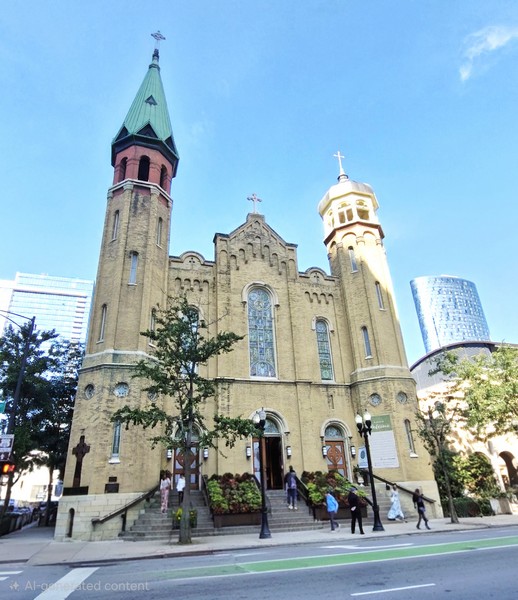
Namba Jinja Shrine (Osaka, Japan)

Namba Jinja Shrine

We were now on our last day in Osaka and we still had time to explore the city as our Cebu Pacific flight back to Manila was still in the late afternoon.  After breakfast at the hotel, my nephew Miguel, who was proficient in Japanese, offered to tour us around before returning to Kyoto to work and study.  We decided to walk to the nearby Namba Jinja Shrine. It was rainy that day.
Torri (Gate)

Nestled along Midosuji Avenue in Osaka’s Chūō Ward, the tranquil, restored Namba Jinja Shrine complex was said to have been founded in the 5th century by Emperor Hanzei, who established Shibagakinomiya Shrine in Matsubara City, Osaka Prefecture, to enshrine his father, Emperor Nintoku. 

Purification Fountain (Temizuya)

It holds the weight of ancient Imperial reverence and civic memory and stands as a historical anchor amid the city’s pulse.  The shrine was later moved to Hommachi, Tennoji Ward, and then moved to its current location in 1583 (Tensho era) after Toyotomi Hideyoshi built Osaka Castle.

Shrine with Offertory Box (Saisen-bako)

It was named “Kami-Namba Shrine” after the area and, later, adopted its current name in 1875 (Meiji era). During the Edo period, with the rise of Inari worship, the Inari Shrine, a branch shrine within the grounds, commonly known as “Bakuromachi no Oinari-san,” became more famous than the main shrine. Uemura Bunrakuken opened a puppet theater troupe within the shrine grounds in 1811 (Bunka era 8).  Destroyed during World War II, the shrine was rebuilt in 1974, with reinforced structures that echo its pre-war architecture.

Camphor Tree

Passing through the sturdy stone torii, we were welcomed by a sacred courtyard framed by modern buildings yet rooted in centuries-old tradition. Today, it has three different shrines with different deities, offering a gentle yet powerful pause with the rustle of leaves, flicker of lanterns, and soft murmur of prayers—a tender heartbeat within Osaka’s fast rhythm.

Cherry Blossom Tree

Known for its lion-dog (komainu) and fox (kitsune) statues and cherry blossom gardens, the shrine is also home to a scorched but unbowed and majestic 400-year-old camphor tree, one of the oldest in Osaka, whose trunk radiates quiet resilience and offers visitors a moment of grounding in the midst of urban haste. There is a belief that if you touch it, you will receive the “power” to rejuvenate yourself.

Fox Statues (Kitsune)
Lion-Dog Statue (Komainu)

Revered within Settsu Province’s Soja shrine network, Namba Jinja Shrine invites prayers for health, prosperity, and protection from calamities. At the beginning of the Meiji era, when Bunrakuken moved to the new development in Kujo, the “Hikorokuza” troupe opened on the site.

Red and Blue Banners (Nobori)
Wish Cards (Ema)

Each summer, the Himuro Ice Festival, held every year from July 20 to 21, visitors and worshippers are cooled by being given crushed kachiwari ice, a charming ritual reminding us of ancient ways to beat the heat.  It is said that if you eat this ice, you will not be defeated by the summer.

Sacred Lottery (Omikuji)

Namba Jinja Shrine: 4 Chrome 1-3 Bakuromachi, Chuo-ku, Osaka 541-0059. Tel: 06-6251-8000.  Fax: 06-6251-5110. Website: www.nanba-jinja.or.jp. Open daily, 7 AM – 6 PM. Admission is free.

How to Get There: Osaka Metro Midosuji Line “Shinsaibashi Station” Exit 3.  It is a 5-min. walk from Exit 13 of Osaka Metro Hommachi Station.

Dotonbori District (Osaka, Japan)

Dotonbori District

The 4-star Candeo Hotels Osaka Shinsaibashi, the hotel that we stayed in, happened to be just 250 m. from Dōtonbori District, the vibrant, popular, neon-lit entertainment and dining district of Osaka for visitors to the city, boasting of a number of well-known restaurants offering a range of traditional and modern Japanese dishes.  Known as one of Osaka’s principal tourist and nightlife areas, the area runs along the Dōtonbori Canal, from Dōtonboribashi Bridge to Nipponbashi Bridge in the Namba district of the city’s Chūō Ward.

Check out “Hotel and Inn Review:  Candeo Hotels Osaka Shinsaibashi

Shinsaibashi Shopping Mall

Dōtonbori traces its history back to 1612, when merchant Nariyasu Dōton, the administrator of local canals, joined by Yasui Jihē, Yasui Kuhē, and Hirano Tōjirō, began construction of the canal on the southern edge of Osaka, aiming to increase commerce by widening the river.

View towards Shinsaibashi Shopping Mall

To get there, we passed through the huge tunnel of the Shinsaibashi shopping mall. We then proceeded to the main gathering spot, often called “Hina-dan,” which offers the best views of the iconic signs. Here, we encountered Kim Jong Un lookalike Howard X (Howard (X) Lee), a well-known professional Australian-Chinese impersonator and political activist.  Considered the world’s first professional Kim Jong Un impersonator, he is frequently spotted in Dotonbori and other Japan locations, holding a toy missile and attracting large crowds.

Kim Jong Un impersonator Howard X

When taking photos with crowds, he often appears in costume and is sometimes paired with Donald Trump impersonators, notably around major events like the 2019 G20 Summit in Osaka. Creating satirical scenes to promote democracy, his appearance sometimes leads to deportation or detention due to political sensitivities. To provoke reactions from North Korean delegations beyond Japan, he has appeared at the PyeongChang Olympics and the Paris Olympics and has a significant presence on social media platforms such as Instagram. 

View from Midosuji Avenue

Evenings are the best times to experience the dazzling, futuristic neon cityscape reflected on the canal.  Here, you can also take a Dotonbori Canal Cruise or city cruise, to see the neon lights from the water, or visit the massive Don Quijote store by the canal.  Though now mostly a dining and nightlife area, the Theater District is historically known as a hub for Kabuki and Bunraku puppet theaters. 

Dotonbori Canal

Centered along the Dotonbori Canal, Dōtonbori (bori from hori, meaning “canal”) is famous for its eccentric atmosphere and extravagant signage (including the iconic Glico Running Man Sign and the massive. 6.5 m. long moving crab sign at Kani Dōraku) and is a top tourist spot for nightlife, shopping, popular spots including Ichiran, and various street food stalls selling takoyaki (octopus balls), kitsune udon and ramen. 

Check out the “Glico Running Man Sign

The author and Grace with the Glico Running Man Sign in the background

Dotonbori is considered as the city’s food capital or kuidaore, a Japanese word meaning to “ruin oneself or go bankrupt by extravagant spending on food” or, more pithily, “eat until you drop.” It is part of a larger proverb: “Ruin yourself with fashions in Kyoto, ruin yourself with meals in Osaka,” reflecting local priorities (and artistry) in the clothing and food of Kyoto and Osaka, respectively.  This phrase, associated with Dōtonbori, is often used in tourist guides and advertisements.

Rows of restaurants at Dotonbori District

On our first night in Osaka, we decided to dine at Botejyu (founded in 1946), located at the second floor of the Comrade Doton Building.   We waited in line for several minutes before finally being seated.  The menu and ordering are accessed on your smartphone via a QR code. 

Botejyu Restaurant

Here, we tried out, among other dishes, the okonomiyaki, a savory Japanese pancake consisting of wheat flour batter and other ingredients (shredded cabbage, eggs, meat, etc.). This specialty’s classic mayonnaise ingredient was developed by Botejyu. 

Ganko Sushi

On another evening, we tried out Ganko Sushi (since 1963) and Torikizoku (a popular, affordable yakitori chain. The latter is located at the Kuidaore Building, in front of which is Kuidaore Taro (also known as the Kuidaore Ningyo), a mechanical drum-playing clown, installed in 1950 as a mascot for the now closed Kuidaore Taro Restaurant which moved to a new location slightly east of his old haunt. Every March the visiting rikishi for the Osaka Grand Sumo tournament used to line up with Kuidaore Taro for photos.

L-R: Jandy, Miguel, Matthew, Nenette, Mark, the author and Grace at Torikizoku Restaurant
The mechanical, drum playing clown Kuidaore Taro

How to Get There: Located in the Minami district, Dotonbori, adjacent to the Shinsaibashi-suji shopping street, is easily accessible near Namba Station.

Glico Running Man Sign (Osaka, Japan)

They say that any visit to Osaka is never complete without a photo-op with the Glico Running Man Sign, one of the most well-known and recognized landmarks in Osaka, in the background.  This iconic, huge, brightly lit neon/LED billboard, located in Osaka’s Dotonbori district, has glowed over the Dotombori Canal in Osaka‘s premier shopping and entertainment district for more than 90 years now. 

Check out “Dotonbori District

Glico Running Man Sign

It shows a runner, against a blue track with Osaka landmarks, reportedly inspired, in part, by the winning form of Fortunato Catalon, an early 20th century Filipino champion sprinter, from Tolosa, Leyte, known in the 1910s and 1920s, as “Asia’s Fastest Man,” in the 100-yard and 220-yard dashes during the 1917 Far Eastern Games held in Tokyo, as well as Japanese marathoner Shizu Kanaguri. It was first installed in 1935 by Ezaki Glico (manufacturer of one of Asia’s most famous confectioneries) company founder Ri-ichi Ezaki, to represent his energy-boosting caramel Glico candy that, according to lore (the Japanese love a backstory), could give you “enough energy to run 300 meters.” This energy product was created in 1922 by adding glycogen from oysters to the snack and, to this day, this running man has been used as the company’s mascot and logo.

Ezaki Glico’s most popular product is Pocky, confectionery-coated pretzel sticks, which comes in a number of tasty flavors, very popular in Japan and abroad (it is known as Mikado in some parts of the world). Glico’s other confectionery products include Pretz, Caplico, Bisco and Karujaga. Glico also makes ice-cream products and a few processed foods and curry roux blocks.  Glico has a museum, at their Osaka headquarters, featuring all sorts of nostalgic packaging and a collection of the free toys that are given away with each box. Currently on display, part of a special exhibition, is a selection of diorama’s of Dotombori and the Running Man billboard.

The sign, which now serves as a symbol of perseverance, energy, health, victory and the spirit of Osaka, has had several overhauls. Since 1972, the huge neon has shown the Running Man on a running track. In 1998,  some of Osaka‘s best-known landmarks, such as Osaka Castle and the Tsutenkaku Tower, were added to the background.  The previous five versions were all neon. The 2014 LED version follows a similar theme, with the landmarks taking a more dynamic role.

The author

Also, through the years, it has been occasionally altered to support the mighty Hanshin Tigers, Osaka’s baseball team (when Japan hosted the Soccer World Cup), and to celebrate various sporting triumphs or celebratory images, such as in 2020, to celebrate Takuma Sato and his second Indy 500 victory (the sign changed every 15 minutes to an image of Sato performing the “Glico Man Pose”).  The current 6th generation sign, installed in October 2014, is the first to use the new high-resolution LED technology which allows even more special events celebrated via the huge billboard.  It is 20 m. high, 10.38 m. wide and is illuminated from sunset until 12 midnight.

Jandy

A popular meeting place and spot to take photos, here visitors, both local and foreign, often mimic the runner’s pose (arms raised, one leg up). For the best experience, visit during the week or earlier in the day, though the sign is truly spectacular at night when the bridge is jam packed, especially at weekends, with people entering the Dotombori entertainment area.  A central point for shopping and food in Dotonbori, the area around the sign is crowded, with other bright, large signs.

Just east of the Glico Man billboard is Ebisubashi, originally constructed to provide access to the nearby Ebisu Shrine.  The bridge, more practically, provides a link between the Shinsaibashi-suji and Ebisubashi-suji shopping districts.  The bridge is also the location of a legendary curse, on Osaka’s baseball team, the Hanshin Tigers, which was considered broken in 2023.

Ebisubashi also makes for a convenient gathering point, due to the familiarity of the Glico Man, hence its nicknames, nanpa-bashi (mostly used by foreigners) and hikkake-bashi (“the pulling bridge”), mostly used by native Japanese.

Glico Running Man Sign: 1 Chrome-10-4Dotonbori Sistrict, Chuo Ward, 542-0071 Osaka.  Tel: +81 120-917-111.

How to Get There: The sign is located at the South bank of the Dotonbori Canal, near Ebisubashi Bridge.

Mitsutera Temple (Osaka, Japan)

Mitsutera Temple

Japan is known for being a heady mix of the old and new, and this is perhaps best exemplified by the way some of its high-rise blocks are carefully built around, or integrated with, ancient temples.  One such example is the ancient, charming Mitsutera Temple, known affectionately as Mittera-san by local residents.  Located along bustling Midosuji Avenue, a major artery in the center of Osaka, its main hall, dating back to the early 1800s, has been neatly embedded at the base of the large, 15-storey, 180-room Candeo Hotels Osaka Shinsaibashi, in the city’s Chuo Ward. The first few floors are atrium-style to provide ample space for the hall.

Check out “Hotel and Inn Review: Candeo Hotels Osaka Shinsaibashi

Entrance to hotel and temple

Mitsutera Temple, founded in the Nara Period (710-784) by the renowned monk Gyōki (one of 49 temples established by him during this period) to serve as a burial site for Emperor Ojin (Japan’s 15th emperor), on the orders of Japan’s 45th emperor, is a member of the Omuro school of the Shingon sect of Buddhism headquartered at Ninnaji temple in Kyoto. After it burned down in the late Edo Period (1603-1867), the current main hall was rebuilt in 1808 and, in 1945, remarkably survived the Great Osaka Air Raid unlike many other wooden structures in the city.

View of temple from Midosuji’s sidewalk
Temple bell (bonsho or tsurigane)

A decline in parishioner numbers and an increasing demand for simplified funerals have made it difficult for the temple to financially survive.  In a rare partnership and an attempt to pass down the temple to posterity, Mitsutera temple entered into a fixed-term land leasehold agreement, of 50 years, with Candeo Hotels Osaka Shinsaibashi wherein Mitsutera will tap into the rent to cover expenses, such as repairs to the main hall and altar fittings.  The construction project was undertaken jointly by Mitsutera and Tokyo Tatemono Co., a property developer based in Tokyo’s Chuo Ward.

The 11-faced statue of the Kanzeon Bodhisattva

From 2020 to 2023, it was physically merged and incorporated into the hotel, which was built directly above the temple. The entire main hall structure was jacked up and, to facilitate the new construction, relocated within the site and moved in one piece to sit alongside Midosuji’s sidewalk, allowing the tower block to be constructed behind and around it. On November 26, 2023, the temple’s main hall was opened there, creating a unique blend of traditional architecture and modern development.

For the aging temple, this creative solution preserved the history and architecture of this centuries-old temple, allowing hotel guests a special experience of staying almost at a temple, participating in religious practices, including morning prayers, eshakyo (transcription of sutra and Buddha images) and meditation. The main hall is within the first three floors.

Mitsutera Temple houses precious Buddhist statues and paintings that Osaka City designates as cultural properties. Decorated in lacquer, gold leaf, and flower petals, the main hall’s center is dominated by an 11-faced statue of the Kanzeon Bodhisattva, with eight other Buddhist statues (including figures such as the Buddhas Yakushi Nyorai and Kobo Daishi, among others) arrayed to the sides. 

This temple offers a black and white goshuin where you need to trace the lines and words color the picture and write your own wish. After that, they will help to stamp the special ink on the completed goshuin. Today, it is a pleasant experience to stroll in the area as the aroma of incense floats next to the fragrance of perfume from the boutiques of high fashion brands which line Midosuji.

Kannon Sacred Lottery (Omikuji) – fortune-telling paper slips found offering guidance on aspects like love, health, and work

Mitsutera Temple: corner of Midosuji Avenue and Mitsudera-suji Sts., 2 Chome-7-12 Shinsaibashisuji, Chuo Ward, Osaka, 542-0085, Japan. Tel: +81 6-6211-1982.

How to Get There: Mitsutera Temple, located near Shinsaibashi-suji and Dotonbori, conveniently situated within walking distance from both Namba Station and Shinsaibashi stations on the Osaka Metro Midosuji Line.

Mega Grand World Hanoi (Vietnam)

Mega Grand World Hanoi

Prior to our departure back to Manila, we made a short stopover at the Mega Grand World Hanoi, a large-scale entertainment and leisure complex that opened in 2023.  Designed to be a comprehensive destination for both locals and tourists, it combines shopping, dining, cultural experiences, and entertainment. This new urban area, mega complex and vibrant festive space, conveniently situated at the heart of Ocean City, to the east of Hanoi, offers visitors a unique blend of top-tier entertainment, upscale shopping, vibrant events, and where visitors can immerse themselves in the rich cultural tapestry of Asia and Europe via a captivating fusion of Asian and European landscapes. 

L-R: Jandy, Grace, the author, Lourdes and Lorraine

It connects the Coral Avenue of Vinhomes Ocean Park 2, the Four Seasons Avenue of Vinhomes Ocean Park 3, and Ring Road 3.5. From the timeless elegance of Venetian-inspired areas and the bustling energy of Korean-inspired zones, Grand World provides endless opportunities for sightseeing and photography.

Jandy and Grace

The lively Venice – Riverside Western Market, featuring an authentic array of colorful shops lining the colorful streets and enchanting banks of the river, offers Italian charm with gondola boats, which are reminiscent of those found on Venetian canals. Visitors can board these gondolas and enjoy a picturesque cruise along the serene, 830-m. long canal, admire the magnificent sunset, explore the diverse shops, and immerse themselves in the vibrant culture that this zone encapsulates. During the ride, you will also get to enjoy impromptu European music performances.

Pedestrian bridge crossing the canal

Crossing the canal is a pedestrian bridge connecting to Asia, with typical Korean ancient houses in the K-Town subdivision.

The bustling K-Town – Coastal Eastern Street, featuring a dynamic blend of traditional and modern architecture, creates a vibrant ambiance reminiscent of some of Korea’s most iconic areas. This zone captures the essence of both ancient and contemporary Korean culture through its diverse offerings, including the upscale Gangnam shopping street, the multicultural Itaewon cultural street, the youthful Hongdae food and art street, and the bustling Myeongdong fashion and beauty street.

Little Hong Kong, a zone that captures the essence of Hong Kong, feels like entering a paradise of shopping, entertainment, and joy. Stepping into Little Hong Kong, visitors can experience the culinary delight and cultural life of Hong Kong, right in Hanoi, as they enjoy an array of experiences that extend from vibrant shopping streets to lively entertainment venues, including lounges, bars, and pubs.

The unique Grand Voyage Show, a special, unforgettable performance held on Asia’s largest outdoor boat stage, brings to life the bustling and magnificent European trade route, crossing the maritime Silk Road, five oceans, and the trading port of Hoi An, Vietnam through captivating performances enhanced by advanced technology, impressive 3D mapping, dynamic sound and light effects, a giant water screen, and a talented cast of over 62 actors.

Gondola ride

The mesmerizing and unforgettable “Journey to the Wonderland,” a circus show presented by a talented troupe of professional performers from China, invites and transports audiences to a new realm of thrilling dreams through the captivating language of elaborate circus performances. With awe-inspiring acts and mesmerizing choreography, the show promises to dazzle audiences of all ages.

The fantastic and delightful carousel ride, with its vibrant colors and enchanting music, offers a nostalgic journey for visitors of all ages as you enjoy panoramic views of Grand World’s bustling atmosphere while being carried away by the gentle motion of the carousel.

Grand World, a shopping paradise that cater to every shopping enthusiast’s needs, boasts a plethora of renowned fashion and cosmetic brands. Visitors can also shop for furniture at Sinh Phu, sofas at Kuka Home, and household appliances at Lock & Lock. 

Come evening, visitors are treated to a dazzling spectacle of lights and colors as fireworks light up the sky above Grand World, adding an extra layer of magic as you’re strolling through the vibrant streets, enjoying a delicious meal at a restaurant, or simply taking in the sights and sounds of the bustling complex.

The serene Tropical Lagoon, a man-made beach with fine white sand and clear blue water amidst urban landscapes, provides the perfect setting for moments of relaxation and rejuvenation. It also boasts an array of artworks, making it a haven for photography enthusiasts seeking to capture quality photos.

Grand World 0ffers an unparalleled culinary experience, with hundreds of renowned domestic and international brands. Visitors can indulge in dishes from Vietnam’s three regions as well as explore unique flavors from Thai, Korean, Japanese, Italian, and American cuisines. After a satisfying meal, you can relax at beautiful coffee shops, bars, and clubs, including favorites like Highlands Coffee, Trung Nguyen Legend, Katinat Cafe, Poseidon Bar, and 729 Club.

VinWonders Wave Park & Water Park, surrounded by blue water and white sand, offers a variety of thrilling and exhilarating water sports activities such as slides, themed playgrounds, and outdoor and indoor pools.

Mega Grand World Ha Noi: Nghĩa Trụ, Văn Giang, Hung Yen, Vietnam.  Tel: +84 1900 232389. Open 24/7 (some activities and services have specific operating hours). You will need to pay for optional experiences like gondola rides or costume rentals.  Entrance fee: Free of charge (some activities and services have specific fees). The main daily show, “The Grand Voyage,” takes place on the Venice River at 9 PM (21:00). Various attractions have different opening and closing times. The gondola ride service on the Venice river operates daily, from 10 AM to 8 PM. The Teddy Bear Museum may have separate ticket prices. A general admission ticket is available for around $150,000 VND. 

How to Get There: Visitors can easily reach Grand World from Hanoi via various means of transportation. If you have a motorbike or car, you can drive to Grand World from Hanoi yourself in just about 50 minutes from the city center. This complex is equipped with numerous parking lots.  Just follow the route: Vinh Tuy Bridge – Co Linh Street – Hanoi-Hai Phong Highway – Grand World. VinBus. which continuously operates, connects Grand World with various locations in downtown Hanoi. Free electric VIN bus service is available from Hoan Kiem and Time City to Grand World Hanoi. 

Hoa Sen Water Puppet Theatre (Ha Long City, Vietnam)

Vietnamese water puppetry

After the end of our Ambrose Day Cruise, we again boarded our coach for the short 6.9-km. drive to Hoa Sen Water Puppet Theatre (Thanh Long Water Puppet Theatre) where we were to watch a water puppet show, a unique art form, central to Vietnamese culture, offering insight into local traditions, rural life, folklore, and historical tales, accompanied by live music. 

Check out “Ambrose Day Cruise

Hoa Sen Water Puppet Theatre

A dedicated venue for traditional Vietnamese water puppetry (Múa rối nước) which originated in the 11th century from the rice-farming villages of the Red River Delta here, we watched ancient Vietnamese water puppetry featuring puppets, made of fig wood carved and painted skillfully in various fascinating shapes as well as symbolic facial expressions, moving on a water stage. 

Shows feature scenes of rice planting, fishing, dragon dances, and folk stories, bringing Vietnamese village life to the stage. Family-friendly, children especially enjoy the colorful puppets and engaging stories.

The stage

Traditionally performed during festivals, celebrations, and special occasions such as the Lunar New Year, over time, it evolved from a humble village entertainment into a distinctive form of traditional Vietnamese performing art. 

The singers to the left of the stage

Aside from Hoa Sen, there are two other water puppet theaters in Halong that are famous for water puppetry: Hoang Gia International Park (Bai Chay Tourist Area) and Yen Duc Village (Dong Trieu District). Since performing water puppets requires a large body of water, Halong Bay is an ideal place to showcase the colors of this rich and special cultural show, making it a popular, easily accessible cultural activity for visitors to the region.

The folk orchestra to the right of the stage

A showcase of the traditional daily lives of Vietnam’s farmers, from their way of making a living on the rice field to how they entertain themselves after hard working hours, the Hoa Sen Water Puppet Theatre covers an area of nearly 1,000 sq. m., with a seating capacity of up to 500 people at one time. It organizes a special performance, combining 16 different local fairy tales with interesting stories about Vietnam’s culture.

The farming theme

The themes of the 30 to 35-minute show focus on the daily life of farmers, folklore, historical tales and the general aspects of the Vietnamese’s spiritual life.  Puppets are manipulated by puppeteers standing in waist-deep water behind a screen, creating a magical effect. To the left and right of the stage are two small folk orchestra of 5 and 7 people, respectively. Currently, there are 3 water puppet shows in a day, with each show lasting from 30 – 35 minutes.

The puppeteers

Hoa Sen Water Puppet Theatre: No. 46 – The 2nd Peninsular, Hoang Quoc Viet, Halong City. Admission: 150,000vnd/pax

Sung Hot Cave (Ha Long, Vietnam)

Sung Hot Cave

The large, mysterious and beautiful Sung Sot Cave (also called “Surprising Cave”), on Bo Hon Island in the center of Ha Long Bay and the Tonkin Gulf, is the largest (it can accommodate up to 1,000 visitors at a time) and, possibly, the most prominent and most frequented by visitors of all the caverns in Halong.  Situated in a limestone massif, with an extremely developed karst terrain, is known for its impressive stalactites that hang from the ceiling, stalagmites that rise from the floor and vast, multi-chambered interior.

The winding stone stairway leading up to the cave entrance

In 1901, French geologist Henri Mansuy, in search of minerals, discovered this cave, describing it as “a cathedral crafted by nature herself,” giving rise to the moniker Grotte de la surprise, “the cave of surprise.” However, this name was not officially recognized until nearly 40 years later when a French travelogue was published in 1938. In 1993, just one year before UNESCO declared Ha Long Bay’s core region as a World Natural Heritage site, Sung Sot Cave welcomed its first visitors. Dubbed the “Opera House of Ha Long Bay,” it was named one of the top ten most beautiful caves in the world by the Czech Association of Travel Agents and Brokers.  

The stone stairway amidst lush vegetation

According to legend, thousands of years ago, during the reign of King Hung, the Van Lang kingdom faced an invasion by the Yin from China. In this moment of crisis, Thanh Giong, a three-year-old boy, miraculously appeared to aid the king. Riding a colossal iron horse and wielding a mighty sword, Thanh Giong, with extraordinary strength and courage, defeated the invaders. Breathtaking Halong Bay is said to be the site of this epic confrontation. After the battle, Thanh Giong ascended to heaven from this cave, leaving behind his legendary steed and weapon.

The cave entrance

Ha Long Bay has many other caves with varying degrees of accessibility and visitor numbers, some of which may be affected by tourism. Other caves with stalactites exist in the bay. Cap La Cave, in the Bai Tu Long Bay area, known for its unique stalactites and pristine nature, though it may not be currently accessible to visitors. Sung Sot Cave is an old phreatic cave which also include Tam Cung, Lau Dai, Thien Cung, Dau Go, Hoang Long and Thien Long.

The first chamber

Nowadays, these caves lie at various heights. From its truncated entrance chambers on a ledge high on the cliff, a passage of more than 10 m. high and wide descends to the south. Covering a total area of more than 12,000 sq. m., the cave is divided into three chambers with a wealth of stalagmites of various shapes. 

A cave pool

The island, and its cave, was the second stop of our Ambrose Day Cruise. Upon arrival at the island, Jandy and I, as well as other tourists from other boats, disembarked and queued up to climb around 100 winding stone steps, surrounded by lush forests, and then descend 10 stone steps to reach the cave entrance which is a small rock breach, 25 m. above sea level, halfway up the limestone mountain. 

Check out “Ambrose Day Cruise

Part of the 800 m. long stone walkway

The path inside the cave was through an 800-m. long stone walkway, with gradual ups and downs, and lit, with colorful lampposts, to highlight its features, creating a vivid tableau and transforming the cave’s cold, empty feeling into a lively, captivating scene.  Some parts have a diffused orange light that creates a fanciful atmosphere, making the space more mysterious and attractive.  A dry cave, it allows for comfortable one-way exploration on foot, with a separate entrance and exit. 

Jandy in front of a cave drapery

At the. first chamber, the smallest of the three chambers at nearly 3,000 sq. m, is likely a “waiting room.” Here, there is a small, serene and shallow freshwater lake formed by rainwater trickling through the limestone cracks in the cave ceiling, with clear water that allows you to view the lake’s bottom, adding to the chamber’s mystical ambiance.  Its ceiling is covered with a layer of “velvet carpet,” with gleaming stalactite chandeliers hung 25 to 30 m. high in the outer chamber, including stone sculptures, banyan trees, dinosaurs, elephants, flowers, seals, etc.

The cave ceiling

The “Stone Waterfall,” on the eastern wall, is a massive, 18-m. wide flowstone formation that appears to be frozen in mid-flow.  Created by centuries of mineral-rich water flowing down a cave wall, its varying mineral content creates striking color variations ranging from pure white to amber and deep russet tones.  

The “Elephant,” near the transition between the first and second chambers, is a stalactite-stalagmite combination with a massive body created by the joining of the ceiling and floor, a clearly-defined trunk and tusks formed by small stalactites.

The second chamber (known as the “Royal Garden”), stretching an impressive 7,000 sq. m., is connected to the first chamber by a narrow rock path.  It opened to an enormous space with and enormous freshwater lake, stunning rock formations and huge and beautiful stalactites and stalagmites in unique and interesting shapes such as a buddha, a bird, a monkey climbing on the rock column, etc..  The “Royal Garden Stone,” a massive, flat-topped formation in the center of the chamber, resembles a royal viewing platform surrounded by stalagmites that look like courtiers paying homage.

The “Stone Curtain,” along the western wall, are thin, delicate (some just 2 to 3 cms. thick) and wavy stalactites that create an appearance of stone curtains or draperies, with beautiful banding patterns caused by varying mineral content.  The “Sword Lake,” a small, sword-shaped pool in the center of the chamber, is said to mirror Hanoi’s Sword Lake.  During certain lighting conditions, the stalactite’s reflection creates the illusion of a sword rising from the water. The “Buddha’s Palm,” a flat, hand-shaped formation near the exit, is believed to resemble Buddha’s hand in blessing.  Though conservation efforts now discourage this practice, many visitors still touch this formation for good luck.

The author with Jandy

Inside this chamber, there are also said to be monkeys scurrying around in quest of food and fun. Compared to the first chamber, this chamber’s karstification process has resulted in a clearer and more ventilated atmosphere due to its ceiling being peppered with thousands of small holes or natural skylights that creates magical light beams during midday hours. There are also several delicate rimstone pools, with crystal-clear waters reaching depths of 30 cms. that reflect the surrounding formations, contain unique microorganisms that have adapted to the cave environment.

The truly breathtaking third and last chamber, further inside, is the biggest chamber, able to accommodate thousands of people. Inside is a 12 m. high rock formation said to be the petrified form of the legendary, stern-faced Vietnamese hero Thanh Giong.

Near the entrance is a stone block, fashioned like a massive, battle-ready horse, and a long sword that Thanh Giong left behind to drive away evil spirits.  Also inside the cave are little ponds and lakes which are regarded as the hoofprints of Thanh Giong’s horse or Giong’s footprints. The cave’s highest point is a “royal garden” with a lake, many plant species, several bird species and panoramic views of the bay.

The cave exit

The final ascent to the cave’s exit took around 275 steps plus another 250 steps, another physical effort, down to the dock. Thought beautiful, with stunning natural formations and a cool, humid environment, our cave exploration was very tiring due to the inclines.

Exiting the cave

How to Get There: Sung Sot Cave, one of the destinations in the tour route 2 (one of 6 routes that bring visitors around Halong Bay), is a short boat ride, from two major ports in Halong – Tuần Châu Wharf (about 12 kilometers from Halong city center) or Halong International Cruise Port (it came into operation in 2019 and is closer to the city center and hence easy to travel), to the island.

To visit Sung Sot cave, travelers must first purchase entrance tickets to the harbor and then boat tickets. Tickets can be purchased at the booth on the right of the entrance of Tuần Châu Wharf. If you want to visit this cave, you need to buy a ticket for route 2, the only one with swimming and full of all kinds of experiences, from visiting caves, boating (or kayaking), swimming, sightseeing and relaxing. This is a half-day tour that lasts from noon to evening. It includes attractions such as Cave Park Conservation Center – Soi Sim Island, Ti Top Island, Sung Sot Cave, Bo Nau Cave, Ho Dong Tien Cave, Luon Cave, Trong Cave, and Trinh Nu Cave.

Entrance tickets for route 2:

Day trip ticket: VND 290,000 (USD 12.1) per person

Ticket for 2 days and 1 night: VND 590,000 (USD 24.6) per person

Ticket for 3 days and 2 nights: VND 790,000 (USD 33) per person

Boat tickets:

The boat fare for individual passengers for route 2 (including Sung Sot cave) is regulated by Halong Bay Management Board as VND 200,000 (USD 8.4) or VND 250 000 (USD 10.5)/pax + entrance ticket (not included) including food, drink and 50 000 VND (2.1 USD)/pax ticket for bamboo boat/kayaking and tour guides). The tour lasts from 5 to 6 hours. The departure times of the boats are 6:30 – 8 AM and 12 – 1:00 PM.

Ambrose Day Cruise (Ha Long, Vietnam)

Ha Long Bay

After breakfast at Tru by Hilton Viet Tri City Centre, we all boarded our coach for the over 4-hour/258-km. drive, including short stopovers at Hanoi and Hai Durong, to Ha Long Bay arriving, before noon, at the Ha Long International Cruise Port which just came into operation in 2019, is closer to the city center and, hence, easy to travel.

Ha Long International Cruise Port

Upon entering the terminal, we walked towards the berthing area of Ambrose Cruise which was to take us on a a modern, 5-star luxury six-hour day cruise of Ha Long Bay.

Ambrose Day Cruise

Launched in 2025, Ambrose Cruise is a 40 m. long, vessel, with three luxurious decks with an area of 400 sq. m.. Built in an elegant and sophisticated Indochina style, it can accommodate up to 99 guests.

L-R: Grace, Jandy, Lorraine and Lourdes at the sun deck
The jacuzzi pool

It has an infinity Jacuzzi pool on the second deck, an ocean-view restaurant and bar, a grand stage with a large LED screen and state-of-the-art sound and lighting systems, and a spacious outdoor lounge area.  I liken it to a “floating hotel” with high-class, 5-star standards.

L-R: Lourdes, the author, Grace, Jandy and Lorraine at the dining area
The lunch buffet

We arrived just in time for a premium gourmet buffet lunch with a wide selection of local traditional Vietnamese dishes, including vegetarian/vegan options, seafood, fish and chicken.  The spacious dining area featured a wooden ceiling, a yellow lighting system and black and white pattern floor tiles. 

Bai Chay Bridge
The Sun Wheel
The cable car tower of Queen Cable Car

We were soon on our way and, as we were dining, we had great panoramic views, from large windows, of the city’s harbor as well as its iconic landmarks such as the breathtaking Sun Wheel (a towering Ferris wheel, with 64 cabins, perched atop Ba Deo Mountain), the Queen Cable Car (known for having the world’s tallest cable car tower and a double-decker cabin) and the Ban Chay Bridge (a unique cable-stayed bridge) and, soon enough, of limestone islands such as Hon Ga Choi, Hon Dinh Huong and Hon Cay Dua.

Bo Hon Island

The first stop in our itinerary was Bo Hon Island where tourists can ride traditional bamboo rafts (a relaxed, local-guided option perfect for families or those wanting to soak in the scenery without paddling) or go kayaking (a self-paced adventure), paddling through the low archway of the natural tunnel of Luon Cave (Hang Luon), into a serene, enclosed lagoon, surrounded by limestone cliffs with lush vegetation, where you can spot rare orchids, ferns and playful golden monkeys.

Tradinional bamboo rafts
Kayaking at Ha Long Bay

Our next stop, also on Bo Hon Island, was Sung Sot Cave/Surprising Cave (Thien Cung Cave), the largest and the most beautiful cave in Ha Long Bay.

Check out “Sung Hot Cave

Sung Hot Cave

After disembarking from the boat, Jandy and I and joined other tourists, from other boats, in exploring the cave’s stunning formations of stalactites and stalagmites and two vast chambers.

Ti Top Island

Our last stop was the 3.7-hectare Ti Top Island, one of the smallest islands making up Ha Long Bay and a not-to-be-missed stopover for tourists in the journey of exploring the bay. Originally called Nghia Dia or Hong Thap Tu, the island was renamed after the Russian cosmonaut Gherman Titov during his visit to Ha Long Bay in 1962. Here, tourist can go swimming along the beautiful, crescent-shaped Vang Trang Beach, with its smooth white sand beach, or hike up 400 steep steps, up a 100-meter high hill, to the island’s peak for spectacular panoramic bay views.

Sunset party at sundeck

Come sunset, a party was held on the sundeck where guests relaxed and served Vietnamese tea, cake, fresh fruits, and snacks.

Sunset at Ha Long Bay

Ambrose Cruises: 173 An Duong Vuong Street, Tay Ho, Hanoi, Vietnam. Tel/ Whatsapp: +84.987.876.013.  Email: contact@cruise-halong-bay.com.

Moana Cafe (Sapa, Vietnam)

Moana Cafe

After our visit to the Fansipan Peak and prior to our departure for Viet Tri (where we were to stay overnight at the Tru by Hilton Viet Tri City Centre), we dropped by the popular, internet-famous 10,000 sq. m. Moana Café, a coffee shop (offering Vietnamese drip coffee, fruit smoothies and simple snacks) and themed photo zone in Sapa perched on a gentle hillside, for a cup of coffee, at the open-air terrace or shaded pavilions, and some sightseeing. 

Open-air terraces

Known for its scenic and panoramic views, on clear days, it has numerous “Instagrammable” themed photo spots, with the misty weather sometimes creating a dreamy, magical effect while taking unique pictures against a stunning natural backdrop. 

The author, with Grace and Jandy, at the Bali-inspired Heaven Gate
The author and Grace at Mini Phu Quoc Proposal Bridge

This curated outdoor experience is a combination of nature, art-inspired installations, and creative photo opportunities.  The atmosphere inside can be described as a mix of art, nature, and a laid-back dining experience and its popularity can mean it gets crowded.  Every corner screams “come take a photo here.”

The iconic White Deer

The art-inspired sculptural installations and fantasy-inspired backdrops include the following:

  • The iconic White Deer
  • Giant blue Angel Wings
  • A pair of black and white Mandarin Duck statues – facing each other, their gracefully curved necks form a striking heart shape.
  • The Mini Phu Quoc Proposal Bridge – split into two sections, it is joined only by the touch of love, friendship and connection
  • A Bali-inspired gate (Bali Heaven Gate) – captures the essence of Bali’s charm in the heart of Vietnam
  • The 6 m. high, maasive and stylized Moana Girl – statue of a young Moana (Vaiana) with firmly closed eyelids, long flowing black hair and outstretch palms longing for the boundless blue sky. Its specifically constructed flooring is paved with transparent tiles, creating an illusion of a clear, mirror-like surface.
  • Infinity Lake – a virtual living spot, it has a white piano in the middle of the lake with clear waters that makes the lake’s surface lookslike a giant mirror reflecting the blue sky and white clouds.
  • A giant golden hand statue – provides ample space for visitors to stand on its palm.
  • The Moana Death Swing (Xich du tu than)– a psychological challenge for those with fear of heights.
  • Moana Sapa Flower Glass Box – nestled within the captivating Sapa-Moana film studio, this mesmerizing and ethereal attraction has an abundance of exquisite pink flowers adorning every corner.  Designed with lovers of the Muse Style in mind, it provides a perfect setting to showcase flowing dresses, cascading locks and gaze filled with dreams.
  • Rose Glass Cage – located to the left of the Moana Girl statue, it is a glass enclosure decorated with rose vines and a small chair.
  • The Giant Love Symbol – a huge 3 m. tall “Love” sign, in soft pastel pink, right on the road to the film studio and set on a platform decorated with charming stilt houses, terraced fields and mountains.
View of Sapa town from Moana Cafe

For clearer photos, consider visiting in the early morning or later in the afternoon. While the mist can be magical, clear weather will give you better views of of the Muong Hoa Valley and Fansipan Mountain.  They offer professional photography and rental of traditional Hmong and other Northern Highlands clothing.

The white piano on Infinity Lake

The place wasn’t cloaked in dense fog during our visit but the line to get a picture with any of this art installations was long and many were taking their time as they took over the space. A clever mix of playful architecture and scenic drama, it wasn’t luxury dining but about the view and the atmosphere.  It was not a deeply cultural experience, in the traditional sense, but rather a play of both fantasy and the majestic reality of the Northern Highlands.

Moana Girl

Moana Café: số 68 Violet, Phường Cầu Mây, Sa Pa, Lào Cai 330000, Vietnam.Tel:+84 853 693 666. Admission: 90,000 Vietnamese dong (includes a drink voucher which you can exchange for a complimentary tea, coffee or soft drink). Open daily, 6:30 AM to 7 PM.

How to Get There: the café is located about 2 kms. from the town center, and can be reached by taxi or motorbike. 

Sun World Fansipan Legend – The Summit (Sapa, Vietnam)

Mount Fansipan summit

Upon arrival at the Fansipan Cable Car Station, there’s still a little more to go to get to the summit of Mount Fansipan.  We had two options – walking up the remaining 600 steps or, from the Fansipan Cable Car Station, we can walk, for about 10 mins., up a wide stone stairway to reach the Do Quyen Funicular Station and take the 2-min. funicular ride to the Truc May Funicular Station, which will bring us very close to the summit, a good option if you’re tired, short on time, or traveling with kids or elderly family members. We chose the latter.

Check out “Fansipan Legend Cable Car

Do Quyen Punicular Station

Mount Fansipan, the “Roof of Indochina,” is Vietnam’s and the Indochinese Peninsula’s (comprising Vietnam, Laos, and Cambodia) highest peak.  Nestled amid the at the gorgeous part of Hoàng Liên National Park, in Lào Cai province, Northwestern Vietnam, this spectacular mountain, well-known for its lively environment, which is home to unusual flora and wildlife found only in this enchanting region, is located only 9 kms. southwest of the lovely Sa Pa Town.

Jandy and Grace beside the Fansipan steel Pyramid

Its height was originally measured at 3,143 m. (10,312 ft.) but, in 1909, this value was later adjusted to 3,147.3 m. (10,326 ft.). Administratively, it is shared between Tam Đường District, Lai Châu and Sa Pa town.

The author (center) with Grace

The weather in Fansipan varies depending on the height – the higher you climb, the colder you feel.  At the top, the temperature ranges from 5°C (41°F) – 25°C (77°F) in the summer and from 0°C (32°F) – 9°C (48°F) in the winter. The humidity is high, from 66% – 95%, with 2 distinctive seasons – wet and dry season.

Fansipan Flagpole

We arrived in time for the moving 10:30 AM flag-raising ceremony (held from Fridays to Sundays and on major national holidays) at the site of the 25 m. (approximately 82 ft.) high Fansipan Peak Flagpole. An iconic national symbol located at the summit of Mount Fansipan, it is the tallest flagstaff in the region and a major attraction for visitors. 

Getting ready to raise the flag

This national architectural masterpiece, considered a sacred symbol marking Vietnamese national sovereignty and pride, was crafted from sturdy Thanh Hoa blue stone and durable Tu Thiet wood which can withstand the extreme mountain weather conditions. The base of the flagpole features intricate carvings representing various key Vietnamese cultural landmarks and ethnic group traditions, including Cham Towers, stilt houses from the Northwest, and the landscapes of Halong Bay. 

View from the summit

The summit is crowned with the iconic Fansipan Steel Pyramid, a triangular landmark.  A must-have photo for every traveler, this 20-kg. stainless steel pyramid monument, inscribed with “Fansipan 3143m,” is a popular spot for taking photos for tourists as it serves as a landmark to prove that one has reached the highest point in Vietnam and the former French Indochina region.

Cafe du Soleil

The initial metal pyramid was made and installed, on the mountain’s peak, by Soviet engineers from Hòa Bình province, in 1985. The amateur mountaineering expedition was the first since the end of the colonial period and was officially timed to the 40th anniversary of Victory Day of the Soviet Union over Nazi Germany. The current pyramid, installed, according to VCCI,  by a group of Vietnamese travelers in 2008.  It is a replacement for an earlier  original but damaged marble pyramid. 

Grace, Lorraine and Lourdes at Cafe du Soleil

At the nearby Café du Soleil, you can enjoy a warm drink and views of the surrounding mountains and clouds.

Fansipan Peak: Coordinates: 22°18′12″N 103°46′30″E

How to Get There: By car, the 332-km. distance between Hanoi and Sapa take only 4 hours. Sleeper buses, suitable for budget travelers, has a longer transfer time than a car, about 5 hours. The convenient and easy trains, a popular choice as this vehicle allows passengers to enjoy the countryside’s scenery along the way, have the longest transfer time of 8 hours.